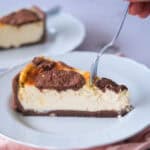
Easy Russische Zupfkuchen ( Chocolate Crust Cheesecake)
This authentic Russischer Zupfkuchen is Germany's most stunning cheesecake! A tender chocolate crust holds a light, creamy quark filling topped with chocolate patches that create a gorgeous black and white pattern. Includes tested quark substitute for US and Australian bakers.
Servings 12 slices
Calories 361kcal
Ingredients
For the Chocolate Crust
- 300 g all-purpose flour USA all purpose flour, UK plain flour, Germany Type 405
- 4 tablespoon unsweetend cocoa powder
- 150 g granulated sugar
- 1 pinch salt
- 150 g butter chilled
- 1 egg medium size
For the Cheese Cake Filling
- 1 kg quark cheese OR 500 g / 17.6 oz cream cheese and 500 g / 17.6 oz Greek yoghurt (10% fat)
- 200 g granulated sugar
- 200 g whipping cream
- 5 eggs medium size
- 40 g corn starch
- 2 teaspoon vanilla extract
Instructions
To make the chocolate base
- Preheat the oven to 180°C/356°F (top and bottom heat). Line a 26cm (10-inch) round springform pan with parchment paper. Grease the sides with butter and dust with flour—this makes removing the cake much easier later.
- In a large mixing bowl, combine the flour, cocoa powder, sugar, and salt. Add the chilled butter (cut into small cubes) and egg. Using a hand mixer, stand mixer, or your hands, work the mixture until it comes together into a smooth dough.
- Reserve ¼ of the dough for topping. Using floured hands, roll half of the remaining dough into a long rope and lay it around the edge of the pan. Press the dough up the sides to create a 5cm (2-inch) high crust. Roll out or press the remaining dough into the bottom of the pan, sealing it to the edges.

To make the filling
- Using a hand mixer or stand mixer with a whisk attachment, whip the cream on medium-high speed until stiff peaks form, about 4-5 minutes. Set aside.
- Using a hand mixer or stand mixer with a whisk or paddle attachment, beat the quark (or cream cheese and Greek yogurt), eggs, vanilla extract, cornstarch, and granulated sugar together on medium speed until perfectly smooth and creamy. Scrape down the sides and bottom of the bowl with a rubber spatula as needed.
- Gently fold the whipped cream into the quark mixture until fully combined. Be careful not to deflate the cream—this keeps the filling light and fluffy.
- Pour the filling into the prepared chocolate crust.
Create the black and white pattern
- Tear the reserved ¼ of the chocolate dough into irregular-sized pieces, press them flat, and carefully place them on top of the filling with small gaps between them—don't cover the entire surface!

To bake
- Place the cake in the preheated oven and bake for 30 minutes.
- After 30 minutes, remove the cake from the oven. Using a sharp knife, make a circular incision about 1cm from the edge, cutting about 1cm deep. This prevents the center from cracking (see photos above).
- Return the cake to the oven and bake for another 30 minutes (1 hour total baking time).
- Baking time varies by oven. After 1 hour, insert a skewer into the center—if it comes out clean, the cake is done. If not, bake for another 5 minutes and check again.
- To prevent cracking, turn off the oven and carefully pull the oven rack out slightly, leaving the door open. Let the cake cool in the oven for at least 1 hour before removing.
Nutrition
Calories: 361kcal | Carbohydrates: 56g | Protein: 16g | Fat: 9g | Saturated Fat: 5g | Polyunsaturated Fat: 1g | Monounsaturated Fat: 2g | Trans Fat: 0.01g | Cholesterol: 87mg | Sodium: 119mg | Potassium: 95mg | Fiber: 1g | Sugar: 33g | Vitamin A: 344IU | Vitamin C: 0.1mg | Calcium: 28mg | Iron: 2mg
